
Sourcing Compliant Slide-On Campers for Australia: The Definitive B2B Payload and Dimensions Guide
For Australian 4×4 stockists, fleet outfitters, and vehicle accessory dealerships across Sydney, Melbourne, and Brisbane, the off-road trayback touring segment represents one of the highest margin categories in the automotive aftermarket. However, retail buyers are becoming increasingly risk-averse regarding vehicle safety, compliance, and legal liability.
When searching for a reliable slide-on camper manufacturer, Australian dealerships cannot afford to import generic, poorly balanced products. In the demanding environments of the Australian outback, incorrect weight distribution and inaccurate dimensional tolerances will rapidly lead to vehicle dynamic failures, catastrophic chassis damage, and severe legal liability for the installer.
At WEVECAR, we function as a tier-one OEM ute camper factory, building heavy-duty, meticulously balanced camper pods engineered specifically for local regulatory compliance. This technical guide outlines the precise physical volume and weight metrics required to pass Australian engineering checks, ensuring your wholesale inventory is completely bush-ready.
Critical Metric: Navigating Weight Limits and Real-World Payloads
The most defining constraint when ordering inventory from a wholesale camper pod factory is weight. Many imported campers look spectacular in a showroom but are legally unusable once loaded with water, batteries, and fuel.
Realistic Payload Threshold of Mid-Size Utes
The cornerstone of the Australian 4×4 touring market is the mid-size platform. Vehicles like the Toyota HiLux, Isuzu D-MAX, Mitsubishi Triton, Ford Ranger, and GWM Cannon dominate both commercial work sites and recreational tracks. While manufacturers claim gross payloads of roughly one tonne, the real-world safe payload limit for off-road touring sits strictly between 500kg and 800kg.
This functional payload must account for the weight of aftermarket steel bull bars, winches, driving lights, passengers, and recovery gear. If an empty camper unit is too heavy from the factory floor, the end consumer will immediately exceed their legal Gross Vehicle Mass (GVM), which invalidates insurance policies and risks catastrophic rear leaf spring or chassis structural failure on corrugated outback roads.
Balancing Component Masses: The Wet Weight Calculation
To maintain safety margins, a premium custom canopy camper B2B supplier must engineer structural lightness into the core design. WEVECAR achieves this by fabricating advanced, lightweight fiberglass camper shells that tip the scales at a mere 150kg to 250kg for the bare structural shell.
This low dry weight is critical because the real-world “wet and loaded” mass escalates rapidly during an outback fit-out:
- Water Storage: A standard 100-liter onboard fresh water tank adds exactly 100kg of dead weight.
- Power Storage: High-capacity dual-battery systems—often comprising dual 100Ah or 200Ah lithium battery banks—add between 50kg and 80kg of electrical equipment.
- Fixed Cabinetry and Amenities: Internal kitchenettes, bed frames, cushions, and dynamic travel luggage add another 150kg to 200kg.
Therefore, the total fully loaded weight of the camper module must be strictly restricted to a window of 500kg to 700kg. Sourcing a hilux camper wholesale product built inside these strict parameters ensures your retail customers preserve adequate payload capacity for fuel, passengers, and camping gear without being forced to invest in an expensive, mandatory aftermarket GVM suspension upgrade.
Tray Dimensions and Cab Configurations: Matching Volume to the Right Chassis
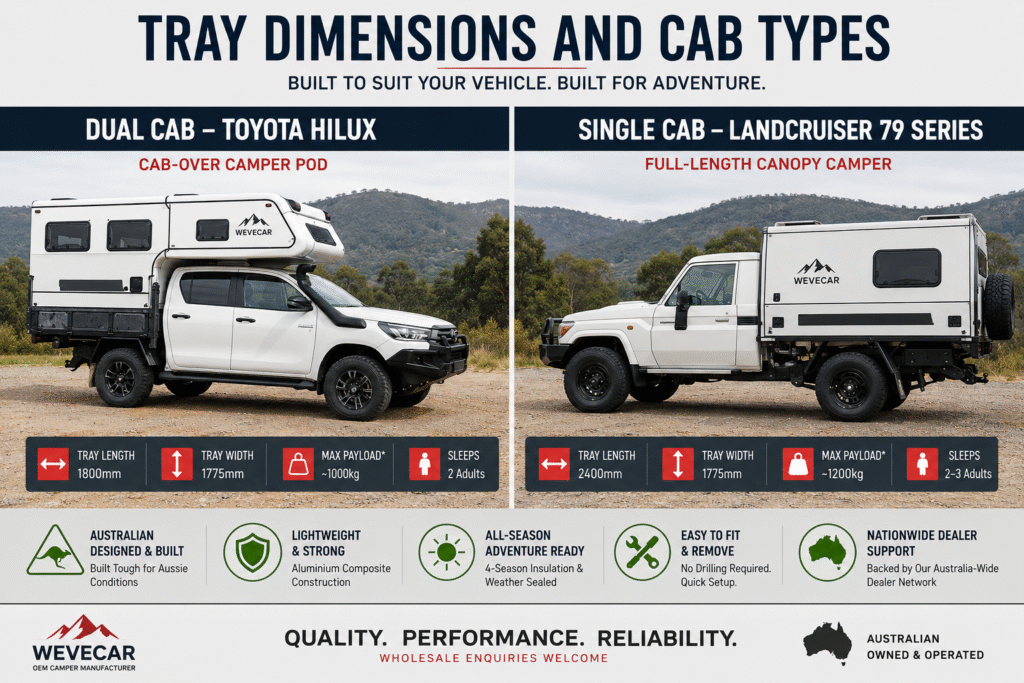
As a high-volume trayback camper supplier, WEVECAR designs distinct camper profiles engineered around the physical constraints of the three core utility cab variations used across New South Wales, Victoria, and Queensland.
Dual Cab (Double Cab) Fitment: Space Optimization & Cab-Over Design
Dual cab utes are the undisputed market volume leaders, serving as dual-purpose family transport and weekend touring rigs. However, they feature the shortest tray lengths, typically measuring a restrictive 1.5 meters.
To deliver comfortable accommodation within this compact footprint, a wholesale camper pod factory must utilize a cab-over or “forehead bed” design. The lower body of the camper pod sits neatly on the 1.5-meter tray, while the sleeping compartment extends forward over the vehicle cabin.
This configuration produces a highly space-optimized internal volume of roughly 6 to 8 cubic meters. The layout must be tightly engineered, focusing on a compact internal footprint that elegantly packs a convertible dinette, a space-saving slide-out kitchenette, and a permanent overhead queen bed.
Single Cab Fitment: Maximizing Internal Living Volumes
Single cab utilities are the absolute workhorses of regional Australia. With an expansive tray length averaging 2.3 meters, a single cab chassis allows a slide-on camper manufacturer to maximize internal living volumes while distributing weight much more effectively across the vehicle’s wheelbase.
A single cab WEVECAR camper pod can achieve an expansive internal volume of 10 to 12 cubic meters. This additional space allows your dealership to offer premium, high-ticket amenities that are impossible to fit inside a dual cab structure. Retail buyers can enjoy full-length permanent walk-around bedding layouts, spacious dining lounges, and dedicated, fully enclosed dry/wet bathrooms with integrated hot-water showers and cassette toilets.
Australian Legal Compliance: The Engineering Science of Center of Gravity
Getting a webpage or product noticed on the Australian market requires a profound understanding of local safety standards. The single most common point of failure for imported campers is an incorrect Center of Gravity (CoG). If the CoG shifts too far to the rear or sits too high, the vehicle becomes inherently unstable and illegal.
                  [ Front Overhang ]
                          │
  ▲                       ▼
  │               ┌───────────────┐
Height            │  Sleeping Area│
  │     ┌─────────┴───────────────┴─────────┐
  ▼     │     [ Heavy Battery/Water ]       │
        └─────────┬─────────────────────────┘
                  │
                  ▼
          [ Rear Axle Line ] ◄─── Target CoG Must Fall FORWARD of This Line
Longitudinal Balance Rule
Under the load compliance framework managed by the National Heavy Vehicle Regulator (NHVR), the total longitudinal center of gravity of a loaded trayback module must always fall forward of the rear axle centerline.
If the camper’s heavy components—such as water tanks and lithium battery banks—are poorly positioned behind the rear axle, they create a lever effect. This lifts weight off the front steering axle, severely reducing front-wheel traction, braking efficiency, and steering response on loose gravel or muddy tracks. As an experienced OEM ute camper factory, WEVECAR maps out internal component placement meticulously, positioning heavy water tanks and electrical management hubs at the absolute lowest and most forward point of the camper floor structure.
Managing Lateral Stability on Washboard Corrugations
The lateral and vertical CoG dictates how a vehicle handles body roll when cornering or navigating off-camber bush tracks. A high vertical CoG creates immense leverage, which places excessive stress on the vehicle’s chassis and suspension components during fast highway cornering. By keeping the structural weight low and utilizing compact pop-top roof mechanisms, WEVECAR campers ensure the overall center of mass remains close to the vehicle’s frame rails, significantly lowering body roll and enhancing high-speed stability on corrugated dirt tracks.
Partnering with WEVECAR: Your Trusted OEM Ute Camper Factory
To scale your retail business and ensure your website secures optimal organic reach, you must back your marketing with structural reality. Sourcing directly from WEVECAR allows your business to market premium, fully compliant overland gear with complete confidence.
Our manufacturing facility is equipped with precision computerized CNC routing systems, advanced vacuum-bonded composite lamination machinery, and certified robotic welding bays. We don’t build generic boxes; we provide customized, legal, and highly insurable assets designed specifically for the unique demands of the Australian continent.
Whether you require a bulk shipment of lightweight dual-cab camper shells for a branded product launch in Sydney, or fully optioned single-cab off-grid touring units for an exhibition in Brisbane, our corporate production team provides comprehensive technical support, precise weight certificates, and engineering data sheets.
Elevate Your Inventory and Increase Inquiries
Navigating the complex realities of Australian vehicle payloads, cab dimensions, and legal center of gravity metrics can be challenging—but it is the only way to build a sustainable, highly profitable 4×4 dealership network.
By offering your customers a product line that is thoroughly certified, structurally sound, and meticulously engineered to protect their vehicle’s chassis, you eliminate after-sales warranty claims and establish your brand as an elite market leader.
Are you ready to update your product selection, capture high-end fleet buyers, and secure exclusive B2B wholesale pricing? Contact the WEVECAR commercial sales team today to request our engineering blueprints, download our wholesale product matrix, and discuss your regional distribution requirements for the upcoming sales season. Let’s build a safer, more robust overlanding standard together. Contact Us.